
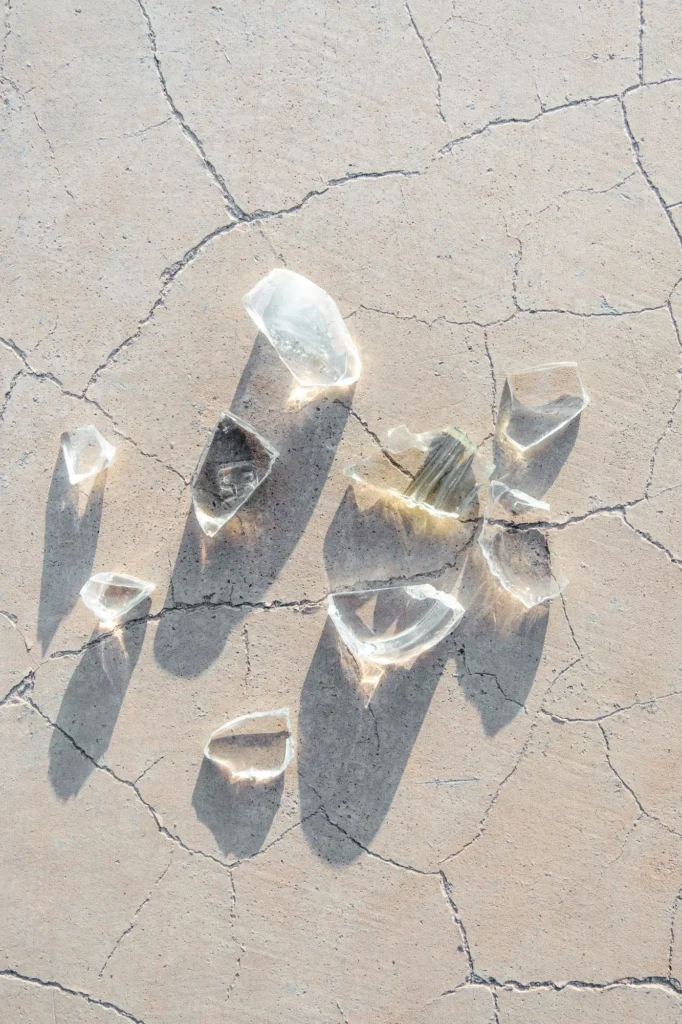
There’s a long-standing myth that glass is a liquid that moves very slowly. Old church windows are often cited as proof of this phenomenon. In reality, these windows are uneven because of medieval manufacturing techniques, not because the glass has flowed over time.
In scientific terms, glass is actually what we call an amorphous solid. It has the rigidity of a solid, but the disordered internal structure of a liquid.
In most solids, atoms are arrange in repeating geometric patterns. In glass, the arrangement seems random, like you would expect from a liquid. Glass looks like this at the microscopic scale because it cools slowly, so the atoms remain in the disordered, almost liquid-like state before they can organize.
While all these facts may seem strange, glass has unique benefits because it is an amorphous solid. Because it is solid but has liquid-like properties, it can be transparent, allowing light to pass through. Additionally, it has similar optical properties from different viewing angles.
Glass may seem trivial in our daily lives, but under the surface, at the microscopic level, it’s really quite interesting! Remember, not a liquid, an amorphous solid!