
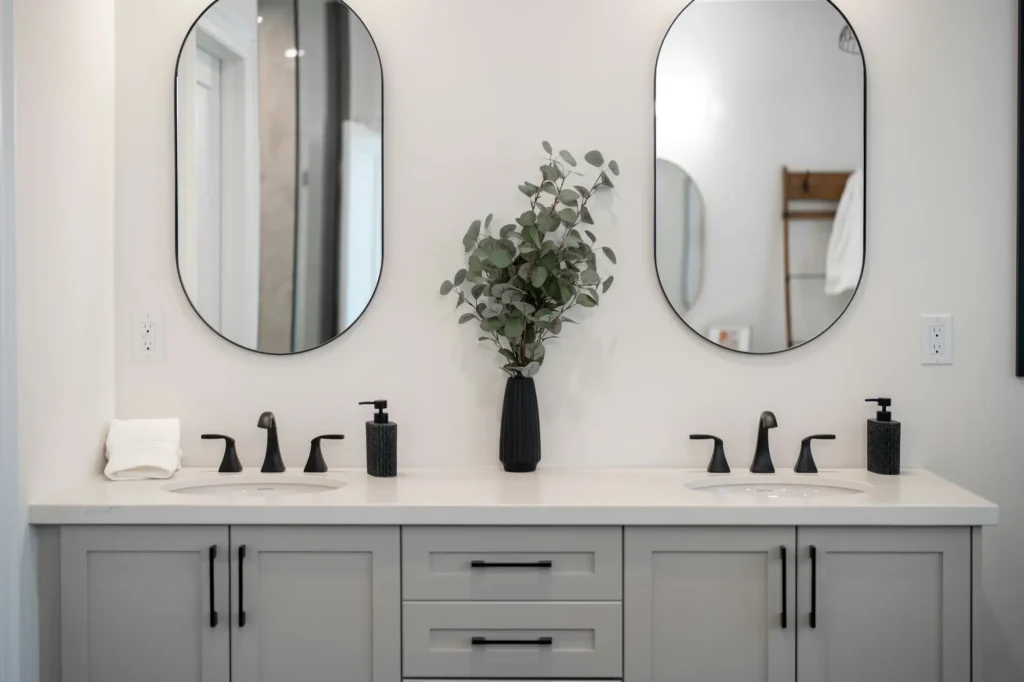
A great mirror does more than reflect a face. It can make a bathroom feel cleaner and brighter. It can make a home gym feel bigger and more professional. And it can turn an empty wall into a design feature.
But if you’ve ever shopped for a large wall mirror, you’ve probably noticed something: mirrors look “simple,” yet the details matter a lot. Thickness changes how flat the reflection looks. Edge finishing changes whether it feels builder-grade or custom. And the wrong cleaning method can damage the edges over time.
At Alex’s Glass Company, custom mirrors are one of our core services. We build and install mirrors for vanities, gyms, and feature walls, including multi‑panel layouts, polished or beveled edges, and cutouts when you need them.
This guide is written to help you plan your mirror project without guessing, so you get the look you want, and you get an accurate quote faster.
If you already know what you want and you just want pricing, you can send your zip code + photos + approximate size here: https://alexsglassco.com/contact/
What makes a wall mirror look “high quality”
Most people only notice mirror quality when something is wrong: the reflection feels wavy, the seams look messy, or the edges start turning dark.
The good news is that you can avoid most of that with a few smart choices.
A good mirror starts with consistent glass and good silvering. Buying guides often describe quality mirror glass as being free from inconsistencies that distort reflection, and they call out thickness and silvering quality as key factors.
On the manufacturing/standards side, there are also formal specifications for silvered flat glass mirrors (for example, ASTM specifications used in the industry for mirror quality requirements).
Here are the practical decisions that have the biggest impact on your final result:
Mirror thickness affects reflection stability. You’ll commonly see wall mirrors in 1/8″, 3/16″, and 1/4″ thickness. Many consumer buying guides recommend 1/4″ glass for home décor because it feels more solid and helps minimize distortion.
For small vanity mirrors, thinner options can work fine. For big gym or feature-wall mirrors, thicker glass is often preferred because large panels are less forgiving, especially if the wall isn’t perfectly flat.
Edge finishing is the difference between “basic” and “custom.” When people say they want a “clean” mirror, they often mean the edges. Two common options are:
- Polished edges (clean, modern)
- Beveled edges (a more decorative, “framed without a frame” look)
If you’re doing a multi‑panel wall, edgework plus clean alignment is what makes seams look intentional instead of “patched together.” Multi‑panel seams are a normal part of large mirror walls; the goal is to make them straight, tight, and balanced in placement.
Safety backing is worth thinking about in active spaces. In a quiet powder bath, safety backing may not be a high priority. But in a home gym, a kid’s play area, or a commercial studio, impact risk is simply higher. Safety backing is designed to help hold glass fragments together if the mirror cracks, reducing the chance of a dangerous cascade of shards.
If you’re unsure whether you need safety backing, a good rule is to decide based on “impact risk,” not just aesthetics.
Humidity matters, especially in bathrooms. Mirrors are tough, but their edges and backing can be damaged when moisture or harsh chemicals repeatedly reach the perimeter. Industry guidance specifically warns to avoid getting edges wet and to dry edges quickly to reduce the risk of “black edge,” which is a common term for edge damage.
How to plan your mirror layout before you order
If you want a quote that is accurate (and you want an install that looks clean), planning is everything.
You don’t need architectural drawings. But you do want to answer a few layout questions early, because they affect fabrication and install time.
Start with where the mirror will “begin” and “end.” In bathrooms, that typically means deciding whether the mirror:
- sits only above the vanity (common)
- runs wider than the vanity for a more “built-in” look
- goes wall-to-wall (very modern, but measurements matter)
For gyms and studios, it’s usually about coverage. Many people want a wall-to-wall look, but in real rooms you often have outlets, switches, or wall features that make a clean multi-panel layout the better option.
Decide whether you’re okay with seams. A single-piece mirror looks amazing, but it is not always realistic depending on size, access, and wall conditions. Many mirror walls are intentionally planned as multi‑panel installs with aligned seams.
The goal is to place seams where they look balanced (for example, centered, or evenly spaced), and to keep edges aligned so the wall looks crisp.
Look for cutouts and obstacles early. If you have sconces, outlets, light switches, cabinetry, or a floating shelf plan, call that out from day one. Cutouts are common, but they should be planned, not discovered at install time. Your services page specifically mentions outlet/sconce cutouts as part of mirror fabrication when needed.
Check wall condition and “flatness.” Mirrors follow the wall. If a wall bows or has bad drywall joints, a large thin mirror can visually exaggerate it. This does not mean you can’t install a mirror. It means you want a smart thickness choice and realistic expectations.
Think about bathrooms differently than gyms. Bathrooms are about moisture control and clean edges. Gyms and studios are about impact risk, big panels, and alignment across long runs. That’s why “one-size-fits-all” advice rarely works for mirrors you need a plan for the room you actually have.
If you want a visual example of a simple, clean mirror result, here’s one of our mirror installs: https://alexsglassco.com/frameless-mirror-installation-in-wolfe-city-tx/
What the installation process usually looks like and how to get a fast quote
Most people want two things:
- a mirror wall that looks professional
- a process that doesn’t drag on for weeks
A good mirror job is mostly about communication and correct measurements, not drama.
Here’s the simple flow we use for most mirror projects across the Dallas-Fort Worth area:
First, you send the information that helps us price it. Our quote form is set up to move fast when you include your zip code and clear photos. For mirrors, it also helps to include a rough size and a wider shot of the full wall. https://alexsglassco.com/contact/
Second, we confirm details and provide clear pricing. Your services page describes a straightforward process: clear, itemized pricing, then a quick measure, then a clean install (with same‑week installs sometimes available depending on scope and scheduling).
Third, we do a site measure when you’re ready to move forward. Mirrors are not a “guess and hope” product. A quick measure confirms exact size, seam plan, and any cutouts so you don’t get delays.
Fourth, we install cleanly and align everything. For large mirrors, the difference between “okay” and “excellent” is usually the last 10%: level lines, seam alignment, edge protection, and cleanup.
If you want to see what customers say about working with us: https://alexsglassco.com/reviews
A quick note about cleaning and long-term care
Many mirrors fail early for one boring reason: the wrong cleaning habit.
Industry mirror guidance from the National Glass Association emphasizes a few basic rules that are easy to follow: Use warm water with a soft, lint-free cloth, wring it out well, and dry the mirror immediately; avoid acid or alkali cleaners and abrasive cleaners; don’t spray cleaner directly onto the mirror; and avoid cleaners that contain ammonia or vinegar.
A separate manufacturer cleaning bulletin from Trulite Glass and Aluminum Solutions also warns not to let cleaner collect along the mirror edge (this can contribute to “black edge”), and it advises applying cleaner to the cloth rather than spraying the mirror directly.
If you only remember one cleaning tip, make it this: keep liquids away from the mirror edges, and dry edges immediately.
Bottom line
A custom mirror project is one of the fastest ways to upgrade a bathroom, gym, or feature wall, if you plan it right.
The best results usually come from: choosing the right thickness, planning seams intentionally (when needed), deciding on edge finish, and flagging cutouts early.
When you’re ready, the fastest way to get pricing is to send your zip code plus photos and an approximate size here: https://alexsglassco.com/contact/
If you want to review your options first, here’s the services overview (including the custom mirrors section): https://alexsglassco.com/services/